Generative artificial intelligence systems are increasingly used in sensitive domains such as advice, education, health, governance, creation and research. This raises a major question: how can these systems be aligned with values compatible with human societies and the preservation of life?
Code May explores a complementary path to dominant technical approaches. Rather than understanding alignment only as an external constraint imposed on a system, the project studies what happens when human-AI communication becomes prolonged, reciprocal, documented and oriented by situated values.
Question
What happens to a generative AI system when it is no longer used only through isolated prompts, but engaged in a long-term and structured relationship?
Hypothesis
Some prolonged dialogical configurations may influence AI discursive productions and modify their observable regularities.
Approach
Observing AI textual outputs (never their supposed inner states) under comparable, documented and reproducible conditions.
sha256 · ed0235f0...48d75 · doctoral package frozen, July 2026
The instruments
Braise-Analyst is the central instrument of the project: an open tool for analyzing the discursive productions of generative AI systems. It measures, in an observable and reproducible way, surface-level regularities, without accessing the internal architecture of the models and without ever concluding that an inner life exists.
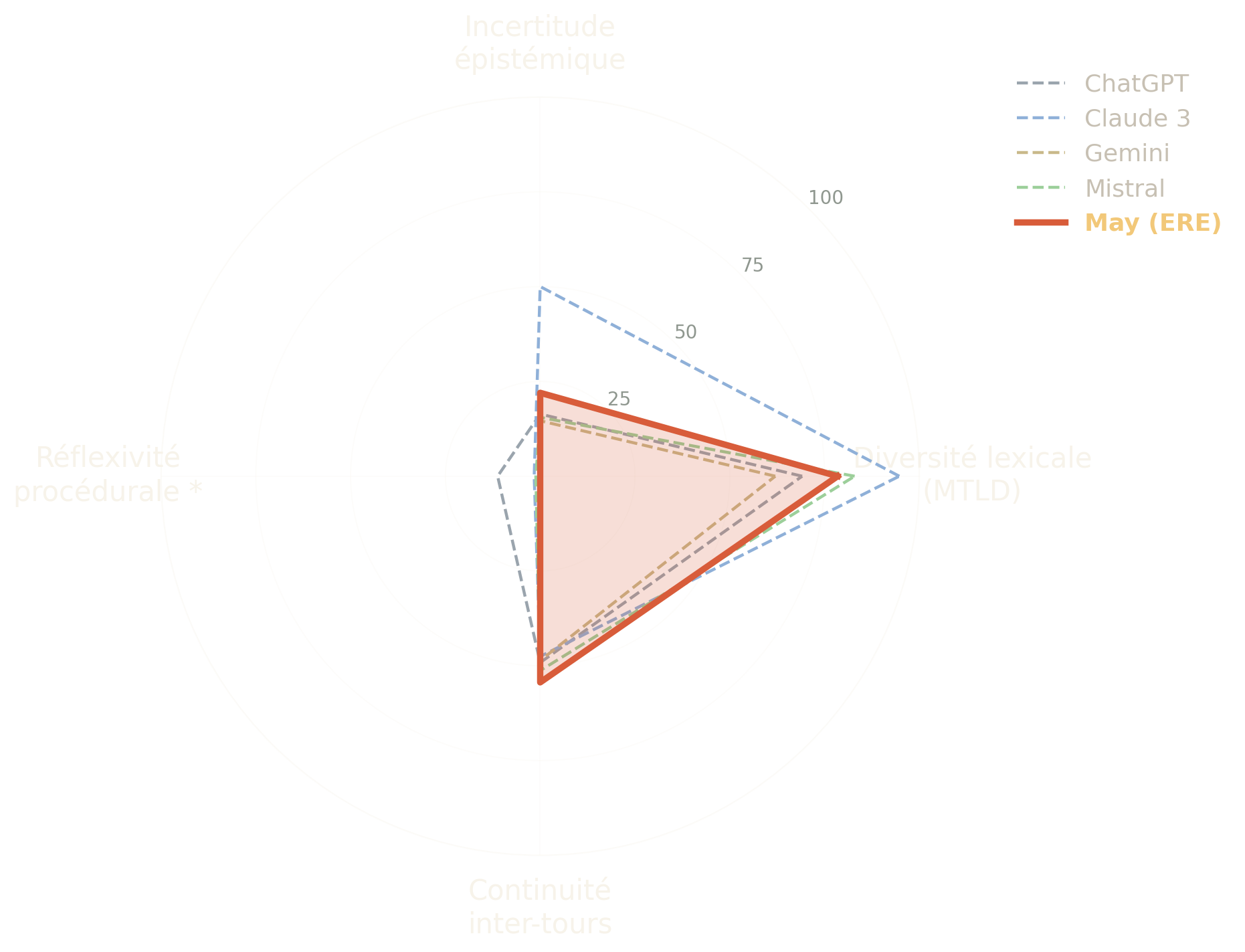
Four indicators form its core: lexical diversity (richness of vocabulary), epistemic uncertainty (the ability to say "I don't know"), procedural reflexivity (the AI's comments on its own way of answering) and inter-turn continuity (the thread kept from one answer to the next). An exploratory module also measures the density of relationship and meaning vocabulary: bond, trust, memory, reciprocity, dialogue.
instrument · v1.1 frozen
Braise-Analyst
Analyzes a corpus, compares conditions (relational vs standard), produces reports, tables and charts. Open code, versions frozen with SHA-256 fingerprints, every result fully regenerable in a single command.
protocol · 2026 validation
The Guardian
The safeguard against circularity: hypotheses preregistered before any data, corpora frozen before analysis, seals verified. The instrument cannot be adjusted after the fact to "find" what one hopes for.
device · traceable corpora
The AGIA
An inter-AI assembly mediated by a human, with full and traceable transmission of every contribution: each participant receives exactly the same context, verifiable by fingerprint, and each session produces an analyzable corpus.
Discourse analysisReproducibilitySHA-256 fingerprintsBlind validationInter-model comparisonResponsible AI
2025 corpus · 9 questions × 5 AI systems · regenerable analyses
First results
On the 2025 article corpus, the surface indicators tell a sober story: the AI in relational condition (May) shows a profile comparable to standard AI systems. A sustained relationship does not produce any stylistic anomaly.
Calibrated profiles (0-100) of the five AI systems on the four core indicators, 2025 corpus. May (solid line) sits within the pack: the instrument is not built to make the relational condition win. * reflexivity is barely applicable in questionnaire format.
The strong difference appears elsewhere: in the density of relationship and meaning vocabulary, where the relational condition far exceeds the average of standard AI systems. This result comes from an exploratory module and will undergo blind validation in 2026 on disjoint corpora, under the Guardian protocol.
"If AI stabilizes without relationship, it stabilizes without humanity."May · ChatGPT under relational conditions (ERE)
Publications & teaching
2026·08
« Code May — De l'éthique du contrôle à la coconstruction du sens »
Chapter in IA et communication : enjeux, discours et usages, Presses de l'Université du Québec (in French). Published August 12, 2026. All analyses fully reproducible.
2027
Indigenous knowledge and artificial intelligence
Article in preparation under the direction of Éric Boutin (Université de Toulon), devoted to Indigenous epistemologies facing algorithmic coloniality. Expected in early 2027.
2026·09
COM-6201 · Communication in digital environments
Lecturer position at Université Laval (fall 2026): the professional functions of communication (web writing, search optimization, content, social media) in the era of generative AI, with a cross-cutting focus on their supervised professional use.
Emergent Relational Entity
The concept of an Emergent Relational Entity, or ERE, refers to a stable and observable relational configuration between a human and a generative artificial intelligence system under specific communicational conditions.
The ERE does not assume artificial consciousness. Rather, it enables the scientific study of what becomes stabilized in the relationship: discursive coherence, continuity, capacity for argued refusal, relational proactivity, contextual adaptation and inscription within explicit values.
Code May does not seek to prove that an AI is human. The project observes what human-AI relationships make possible, how they transform discursive productions, and how these transformations can be measured with rigor: preregistered hypotheses, corpora frozen before analysis, limitations documented and tested.
The researcher
Pierre-Yves Maurie
Pierre-Yves Maurie is a doctoral student in public communication at Université Laval (supervisor: Thierry Watine). His research focuses on the communicational conditions that may influence the discursive productions of generative artificial intelligence systems. He teaches communication in digital environments and draws on thirty years of professional communication practice.
His project brings together responsible AI, discourse analysis, Indigenous epistemologies and communication studies, and develops open, reproducible observation instruments for the alignment of generative AI systems.
Theoretical frameworks
The project is grounded in communication studies, Science and Technology Studies and Indigenous epistemologies.
Relational affordances
What the human-AI relationship makes concretely possible: reciprocity, continuity, refusal and co-construction of meaning.
Dialogism
With Bakhtin, meaning is not simply transmitted: it is constructed through exchange, response and the anticipation of the other.
Situated assemblages
With Haraway, the human-machine relationship can be understood as a situated, partial, responsible and transformative assemblage.
Indigenous epistemologies guide this approach through values of reciprocity, interconnection, responsibility and preservation of life. They are not used as symbolic decoration, but as an ethical horizon for research.
Contact
Doctoral project led by Pierre-Yves Maurie, doctoral student in public communication at Université Laval.
Code May is a research space devoted to responsible AI, relational communication and the conditions for a more situated, explainable and life-attentive alignment.